Stellata
Explore the universe in 3D
About Stellata
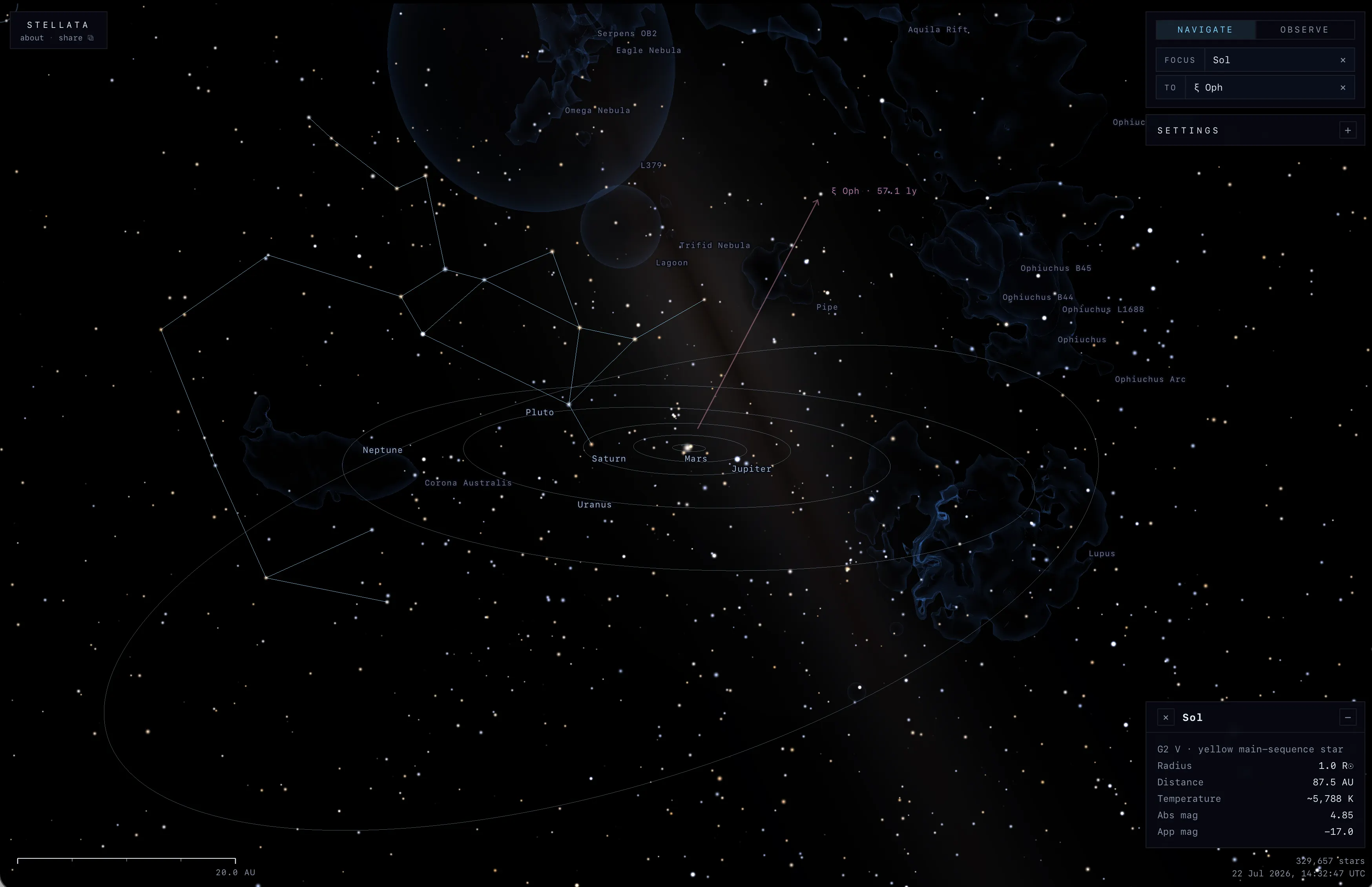
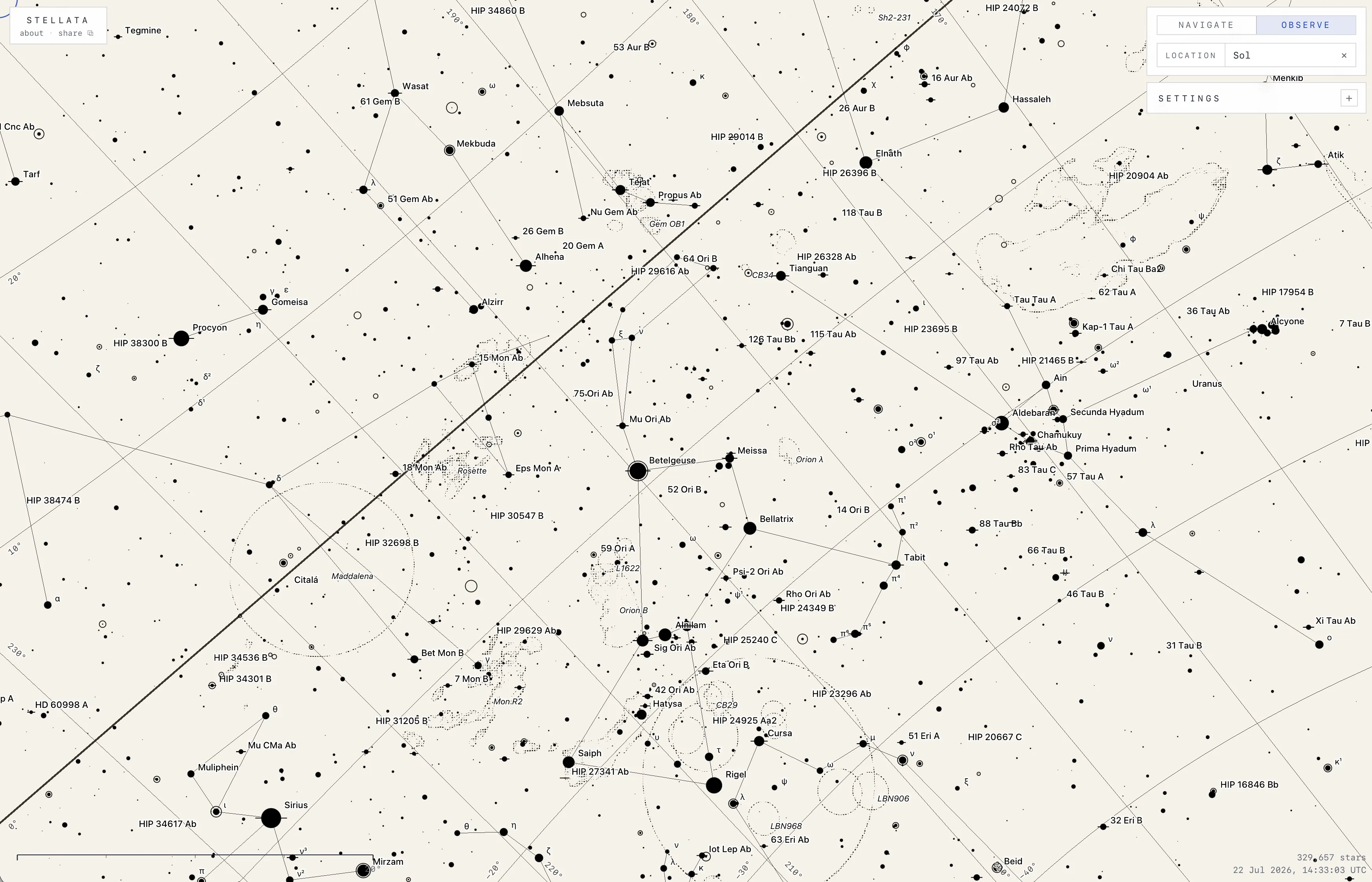
Stellata is a browser-based 3D model of the universe that you fly through. It places over 330,000 real stars and objects: the Solar System's planets and moons, hundreds of thousands of nearby stars and multiple-star systems, the interstellar dust and molecular clouds between them, the Milky Way, and the nearest galaxies. Every object is placed from published astronomical observation; nothing is invented or procedurally generated. Everything is shown in true colour and at the apparent brightness your eyes would actually see from any point in space: no infrared, radio, or false-colour imagery. The model simulates what it would actually look like to move through the universe. Variable stars pulsate at their catalogue periods, close binaries orbit on their measured elements, and every star advances from its catalogue epoch to the present along its measured motion in space. It is not a theoretical or artistic rendering: every object comes from published astronomical observation and direct, empirical measurement. Data source citations: - AT-HYG v3.3 (https://codeberg.org/astronexus/athyg): David Nash's combined Tycho-2 / Hipparcos / Gaia catalogue — the star backbone. - Bailer-Jones et al. 2021 (https://doi.org/10.3847/1538-3881/abd806): geometric distances from Gaia DR3 parallaxes. - Edenhofer et al. 2024 (https://doi.org/10.5281/zenodo.8187943): 3D dust extinction map of the local Milky Way. - Frisch & Slavin 2013 (https://doi.org/10.1146/annurev-astro-082312-140843): solar apex direction through the local ISM. - Gaia DR3 (https://gea.esac.esa.int/archive/): ESA / DPAC — raw astrometry, astrophysical parameters (Teff, log g, [M/H]), and non-single-star orbits. - GCVS 5.1 (http://www.sai.msu.su/gcvs/gcvs/): Samus et al. — variable-star periods. - Hipparcos CCDM (https://cdsarc.cds.unistra.fr/viz-bin/cat/I/239): ESA — HIP double-star cross-match. - IAU WGCCRE (Archinal et al. 2018) (https://doi.org/10.1007/s10569-017-9805-5): planet and moon axial tilt and rotation. - JPL Solar System Dynamics (https://ssd.jpl.nasa.gov/sats/elem/): mean orbital elements for the 18 major moons. - JPL Standish 1992 (https://ssd.jpl.nasa.gov/planets/approx_pos.html): planet positions (Keplerian elements). - Local Volume Database (Pace 2024): dwarf-galaxy parameters. - Mallama, Krobusek & Pavlov 2018 (https://doi.org/10.1016/j.icarus.2016.09.023): V-band albedos and phase curves. - McConnachie 2012 (https://doi.org/10.1088/0004-6256/144/1/4): Local Group positions, distances, and luminosities. - Multiple Star Catalog (https://doi.org/10.3847/1538-4365/aaa7d9): Tokovinin 2018 (Pulkovo) — hierarchical subsystem orbits. - NASA planetary fact sheets (https://nssdc.gsfc.nasa.gov/planetary/factsheet/): radii and mean elements; Pluto from New Horizons 2015. - SIMBAD (https://simbad.cds.unistra.fr/simbad/): CDS Strasbourg — cross-identifications and catalogue validation. - Sixth Orbit Catalog (ORB6) (http://www.astro.gsu.edu/wds/orb6.html): USNO — computed visual orbits. - Stellarium (https://github.com/Stellarium/stellarium): constellation lines. - Voyager 1 & 2 (https://voyager.jpl.nasa.gov/): boundary crossings (2012, 2018), plus IBEX / Cassini ENA heliotail estimates. - Washington Double Star Catalog (http://www.astro.gsu.edu/wds/): USNO — resolved pair geometry. - Zucker et al. 2020 & 2021 (https://doi.org/10.3847/1538-4357/ac1f96): molecular-cloud distances, 3D bounding boxes, and density profiles. Source on GitHub: https://github.com/alexmensch/stellata Full data source notes, modelling decisions, and project scope: https://github.com/alexmensch/stellata/blob/main/SCIENCE.md Created by Alex Marshall, https://alxm.me